
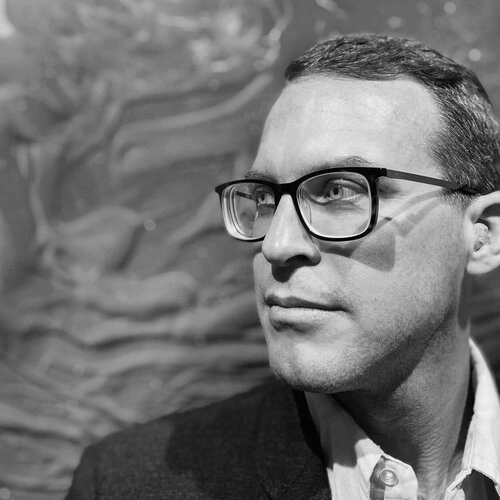
Will Cordeiro is the author of the poetry collection Trap Street, winner of the Able Muse Book Award (2021), and the fiction collection Whispering Gallery (DUMBO Press, 2024) as well as co-author of Experimental Writing: A Writer’s Guide and Anthology (Bloomsbury, 2024) and the forthcoming New Foundations of Creative Writing (Bloomsbury, 2027). Will has published work in 32 Poems, AGNI, Bennington Review, Best New Poets, Copper Nickel, DIAGRAM, Pleiades, RHINO, and The Threepenny Review. Will received an MFA and a Ph.D. from Cornell University and taught for roughly a decade in Northern Arizona University’s Honors College. Will also write plays, essays, and criticism. Will co-edits Eggtooth Editions and currently lives in Guadalajara, Mexico.
Lisa Mottolo: Will, thank you so much for taking the time to do this interview with us, and for attending our residency in Austin, Texas. We wanted to chat with you about experimental literature, your engagement with community, and your attention to place and environment. We’re also excited to hear about your creative process, what’s currently inspiring you, and what you’re working toward next.
You’ve lived in New York City, Upstate New York, Arizona, and now Guadalajara, Mexico. How do the different places you’ve called home influence the tone and subjects of your work? Are there specific sensory details from these places that you find yourself carrying into your work?
Will Cordeiro: Thank you so much! I am very grateful to all of you at Lit Fox Books for the residency in Austin and the opportunity to be interviewed. I appreciate the great work you put into your press and operations. Receiving the residency has meant a lot to me, and it has given me inspiration and impetus to keep up the small, steady toil that a life spent writing requires.
Many of my poems and essays directly address place—place as landscape, as ecosystem, as history, as climate, as culture, as psychogeography, as a site of making and imagination. Place as the mix of all these motley things. A poem might explore the weather, the local fauna, the urban nexus, or the sedimented layers of the past. I still live among the ghosts of all my old cities and environments; I still inhabit the revenant landscapes of my bygone days. The muckage and roar of the subway in New York. The snowdrifts in Ithaca and the waterfalls that froze. The evening light that backdrops the Santa Catalina mountains. The dust-parched badlands of the Painted Desert. The bustling mercados and tianguis here in Guadalajara. Indeed, I wonder if there may be a genius loci, a protective spirit that guards each node of the world.
In another sense, though, maybe place doesn’t really exist. “Place there is none: we go backward and forward, and there is no place,” St. Augustine says. To return to a place is never to encounter the same thing: every site is the sheer flux of a Heraclitean fire. Territories are the palimpsests of eroding maps. Any place is a transient artifact of memory, and both memory and the habitations that memory records are ever changeful. “A traveler’s the sum of all his roads,” says Antonio Machado. The roads are crossways and sidetracks—the shadows of one’s inner space: a shifting passage, a laggardly excursus, much like a dirt track composed (and discomposed) by the steps taken upon it.
LM: In your application for the residency, you mentioned “much of my work responds to natural settings and encounters.” Did you find the Austin setting influenced your work or inspired you to work?
WC: The quiet residential neighborhood of East Cesar Chavez was a wonderful place from which to explore the city. The proximity of Lady Bird Lake and the abundant network of parks, trails, greenways, and riverside paths nearby provided daily encounters with wildlife even within the urban setting. I saw herons, cranes, lizards, squirrels, and turtles, as well as the nesting Quaker parrots. The location is perfect for running, as well. In my short time in Austin, I was able to visit many other neighborhoods, too, including downtown and Sixth Street, South Congress, the UT Campus area, the Boggy Creek greenbelt in East Austin, and the Rainy Street Historic District. I took in the city by foot, which limited my range somewhat, but allowed me a more intimate feel for the texture of different communities on the ground. I could be a flâneur through the bustling streets and then stroll back along the tranquil waterfront, experiencing such divergent environments in a single outing.
I got lucky. The one day of rain, I visited the Blanton Museum. As soon as I stepped inside, a thunderstorm poured down. The museum had many highlights for me, such as an exhibition featuring pieces by New Mexico artists Nora and Eliza Naranjo Morse. I also enjoyed seeing an ancient Greek dinner plate decorated with squid and fish—a kitschy, quotidian ceramic item juxtaposed to the classical red-vase pottery on display. A few other standout pieces for me included The Broad by Jay Lynn Gomez, Restoration by Noah Purifoy, and the op-art piece Incliné bleu et noir by Jesús Rafael Soto. The Blanton has a rich, eclectic collection which is especially strong in work from the United States and Latin America. It was the perfect excursion for a rainy afternoon. When I finished, the day was bright again.
During my week in Austin, I stopped by the Austin Public Library’s Central building downtown to get my poetry fix. Another day, I checked out the Terrazas branch location, where I happened to pick up Renata Adler’s Speedboat for $1 at the book sale. I read most of Augustine’s Confessions on the trip, too, while sitting in coffee shops, and a chapbook of essays in Spanish while lounging in the cowboy pool during the evenings after I ran. I doodled lines in my notebook, drafted a handful of poems, revised some old stories, and scribbled some notes here and there. For me, writing often accretes through a process of lots of twiddling, tinkering, jaunts and jottings, soodling around, hauntings, broodings, besotted think-thinks, just letting things go to diddly squat, and then whittling all the inklings and twaddle back down to something chewed-over, souped-up, and taut.
There are still some pockets and vestiges of “weird” Austin left. Right up East Cesar Chavez Street, for example, you can find Coco Coquette’s wig and glitter store, an escape room, a massage and tarot parlor, a vegan food-truck paradise, Drinks record store, the Lovebirds lounge, a couple Mexican restaurants, an upscale pizza joint, and a few dive bars all cheek by jowl. I last visited Austin—admittedly little more than passing through for a day—during its hipster highpoint, twenty-some years ago. The city felt vibrant and a bit scruffy, a hotbed for working musicians and artists. Lately, I’ve been pondering how Austin has changed from a music scene to a tech epicenter. Maybe I’ll be able to assemble my notes on Austin into an essay at some point soon.
LM: You’re invested in experimental writing, and you’re the co-author of Experimental Writing: A Writer’s Guide and Anthology (Bloomsbury, 2024). What would you say experimental writing can offer to the writer and reader that more conventional writing can’t? And do you have any book recommendations for those interested in reading experimental writing but not sure where to start?
WC: To be honest, I probably read “traditional” work more often. I’ll confess, moreover, that I’m not sure what experimental literature is, exactly, or if it’s worth bothering to define it. You can’t circumscribe experimentation in advance since there’ll always be someone who will want to exceed or defy your parameters, right? That said, linguistic signification is based on conventions. That’s just in the nature of symbols, of words. We all must use conventions, or they’ll use us. Personally, I often conceive experimental literature as a countertradition, as sets of various alternative conventions, in fact. It operates by codes and communities and subgenres and histories and practices much like other evolving forms of literature. The conventions of experimental literature just happen to be contra, offward, or athwart the more familiar, mainstream bodies of literature. Experimental literature may be imbricated within canonical literature, as well, since Gilgamesh or e. e. cummings or the I Ching or Kafka or Middlemarch remain evergreen in their subversiveness: they remain, perhaps, a kind of permanent avant-garde.
I taught a class on “Experimental Writing” for Literary Cleveland earlier this summer. I suppose many young writers like experimental writing because they feel constrained by “judgment” and “rules.” They want to break away from formulas; they don’t want to comport to standards, whether because they are bored by those standards or, in many cases, don’t fully understand them. Experimentation, at its best, introduces a spirit of fun and playfulness back into writing. It can be revelatory or revolutionary. We want work to take us aback, to spellbound us, to leave us flabbergasted. As writers, we often want to take risks and reach new perceptions of reality. Whereas, by contrast, much of what folks read—if they do read—can seem hidebound and trite, a bit basic and cliché.
The book Experimental Writing contains an anthology, so that’s one list of experimental writing to start from. We also have an online supplemental page that gives lots and lots of links to examples in different categories such as hybrids, conceptual writing, new media, or performance, here. Just off the top of my head, though, here’s some more experimental(-ish?) work in the standard genres:
Fiction
Seven Men by Max Beerbohm, Cosmos by Witold Gombrowicz, The Box Man by Kōbō Abe, The Beautyful Ones Are Not Yet Born by Ayi Kwei Armah, Cobra by Severo Sarduy, 60 Stories by Donald Barthelme, The Lover by Margarite Duras, Mumbo Jumbo by Ishmael Reed, The Plains by Gerald Murnane, Arthur’s Whims by Herve Guibert, Oreo by Fran Ross, New Veronia by M. S. Coe, and Fiskadoro by Denis Johnson.
Poetry
Ashes for Breakfast by Durs Grünbein, The Sky Was Once a Dark Blanket by Kinsale Drake, ARK by Ronald Johnson, The Book of Frank by C. A. Conrad, Selected Poems by Adonis, Thrown in the Throat by Ben Garcia, Heard-Hoard by Atsuro Riley, My Life by Lyn Heijinian, Alma Venus by Pere Gimferrer, Selected Poems by Marina Tsvetaeva, and Dance Dance Revolution by Cathy Park Hong.
Essays
The Argonauts by Maggie Nelson, Bright Archive by Sarah Minor, Float by Anne Carson, Known and Strange Things by Teju Cole, On Immunity by Eula Biss, and The Story of a Life by Aharon Appelfeld, Straw for the Fire by Theodore Roethke, Dialogues with Leucò by Cesare Pavese, The Waste Books by Georg Christoph Lichtenberg, The Little Virtues by Natalia Ginzburg, In Cold Blood by Truman Capote, Hydriotaphia by Sir Thomas Browne, Euphues by John Lyly, The Book of Disquiet by Fernando Pessoa, and Up in the Old Hotel by Jospeh Mitchell.
Plays
The Pretty Pretty by Sheila Callaghan, The Skriker by Caryl Churchill, Straight White Males by Young Jean Lee, Dry Land by Ruby Rae Speigel, Ruined by Lynn Nottage, Loot by Joe Orton, Angels in America by Tony Kushner, Venus by Suzan-Lori Parks, The FLUXUS Workbook, and The Bad Infinity by Mac Wellman, 4.48 Psychosis by Sarah Kane, One Thousand Avant-Garde Plays by Kenneth Koch.
LM: You’re currently working on a number of projects. Do you see a common thread, perhaps an underlying question or concern, that connects all your projects?
WC: Any connecting threads are for others to discern. I often prefer pushing off in new directions; I want to keep exploring different ideas and subjects, genres and artistic practices. I’d rather not become someone who repeats themselves too much; though I’m sure I repeat myself quite enough as it is. I like artists and thinkers who reinvent themselves, enlarge their vision into unforeseen paths. Even if it means turning their backs on the work they did before. I don’t want to become a brand, a platform, a program.
As an artist, you take whatever energies are given to you, ultimately. You cultivate as wide a purview as you can. It helps to embrace such pluralism if you’re not going to get stuck in some rut. Indeed, I try at times to consciously work against my own directions and predilections. My first book included many poems that used meter, form, and rhyme. My second book was a collection of weird little prose parables and flash fiction. Last year I cowrote a libretto for a rock opera, a family drama that was driven by the tensions between natalism and climate change, among other themes. Such work seems more different than the same—or perhaps that’s just my hope.
Currently, I’ve been making an effort to read simpler, more earthy and understated poetry: for example, Umberto Saba and Jane Kenyon. I want to be able to adopt a spare, prosaic style that relies on narrative content and unadorned declarative statements. My impulse sometimes is toward the baroque: toward soundplay and formal maneuvers and fanciful conceits. I’m often invigorated by formal virtuosity and involuted figuration. But I don’t want that to define me; I want to have a more toned-down, barebones style in my toolkit, too. I want to develop a frank, unadorned, downhome, and gritty flavor. A counterbalancing roughage to the complex mouthfeels and notes I load up in my sauce, as it were. Or maybe what I’m suggesting is that I don’t want to keep cooking up the same thing: I aim for a wider and more generous palate: a little of this, little of that, with some nouveau fusion mixed in.
Maybe I don’t connect threads. Maybe I’m happy unraveling and being at loose ends?
LM: Looking ahead, what ideas, themes, or questions are you eager to explore in your future work, and why do they feel important to you right now?
WC: Robert Penn Warren once said, “When you start any book, you don’t know what, ultimately, your issues are. You try to write to find them. You’re fiddling with the stuff, hoping to make sense, whatever kind of sense you can make.” The idea of urgency or kairos or taking up hot-button issues in a poem feels (how can I put it?) almost frivolous to me. I don’t think poetry speaks truth to power since the powerful don’t read poems.
I am inclined, however, to agree with Shelley’s declaration that “poets are the unacknowledged legislators of the world.” Unacknowledged being the key word here. Poets, and artists more generally, legislate by creating images, metaphors, and paradigms. These engines of analogy may eventually pass into greater cultural currency where they become touchstones and models that inform social action. In The Decay of Lying, Wilde remarks, “At present people see fogs, not because there are fogs, but because poets and painters have taught them the mysterious loveliness of such effects.” He attributes this newfound perception of reality—fleeting glints and hints of nebulous mist over the Thames—to the vogue for the Impressionists. Poets construct the paradigms which bound the laws of what it’s possible to think. A poet’s work is covert and roundabout but nonetheless vital and ubiquitous; without such tropes and symbols, the citizenry has no loadstar to guide it. We’re bereft of any mythopoetic blueprints.
It’s the small things that can affect me—a leaf falling, a shadow swaying, the sun striking the water. These more often impel a contemplative response, a philosophical inquiry, an inward reflection for me. Don’t get me wrong, I believe things like climate change, the development of AI, and contemporary geopolitical issues are enormously important. But it’s not the kind of importance that poems—at least my poems—can adequately address. By contrast, nature, love, grief, growing and aging, understanding one’s place in the universe: such things feel like more than sufficient material. Someone once said, “Poetry would be the praise of god, if god existed.” As for the manifest subject matter—that consists of almost anything, the daily residue of chance items. Through attention and puzzling and a little sifting, you scoop up the rich silt and pebbles passing by as if with a seine-net from the river of experience. You pluck whatever seeds float across your imagination.
I like when my poems are oblique—when they catch at something other than what they seem like they’re about: that’s the way that figuration operates. They don’t often have a clear takeaway, even if they have a succession of narrative events. They leave space for the reader to enter them. They exist to be wrestled with. An Arshile Gorky quote I read in the Blanton Museum gets at this: “The trouble is, everyone uses their arms too much…. I want the ghost of a painting.” Gorky aims for traces, ambiguities, suggestions. Not that a poem needs to be abstract in any way. But the language should create a penumbra that invites the reader’s imagination, lacunae that require the reader to fill them in.
LM: You do a lot of work for the community, from volunteer grant writing to serving as an executive board member for the Northern Arizona Book Festival and co-editor for Eggtooth Editions. Can you share a moment from your community work that encapsulates why it’s necessary to do this work?
WC: The ecosystem of small presses and journals, within poetry especially, is a community affair. There’s no real money in it. With a few exceptions that prove the rule, the Big Five conglomerates—that is, presses like Penguin Random House—are leaning evermore toward a bland corporate monoculture. Promoting art is a secondary or tertiary goal for them; they’re just another enterprise aiming to push product and recoup their beaucoup bucks. Books are simply the widgets they happen to shill. Literature is becoming a niche subfield in the face of the encroaching dominance of social media, videogames, podcasts, online gambling, artificial intelligence, and other forms of distraction.
In this zeitgeist, then, the same small cadre of folks often need to contribute both as writers, on the one hand, and as community builders, on the other. Almost everyone’s pulling double or triple duty to make the grassroots system of small presses and literary institutions at all sustainable—short-lived though many journals, reading series, or platforms may be. I don’t think I’m unique in the multiple roles I take on.
Most every writer I know also acts as a volunteer, editor, grant writer, administrator, website designer, reading series coordinator, literary critic, and/or board member of a community organization. Without engaging in this additional form of labor—and, yes, sometimes grunt-work—in addition to writing itself, the ecosystem would collapse. True, within this tight little circle, where everyone wears multiple hats, there are dangers for nepotism to occur: mutual backscratching, bootlicking, matchmaking, and lots of incest and petty squabbles.
However, the benefits of such a mutualist system include that writers understand the behind-the-scenes editing process better and have a greater role in institutional decision-making. The need to engage in such community work has become known as “literary citizenship,” this notion that writers themselves have a duty to contribute to the institutional structures that sponsor literature in a bottom-up way, which also gives them a greater voice in how it’s constituted, what gets programmed; they can see the sausage being made.
Largely I think it’s the only viable path forward since literature increasingly exists off to the side of mainstream, monetary endeavors. Today, established pipelines of grants, philanthropy, and state support for the arts are drying up in the US. The fate of literature in our hypercapitalist society is ironically not unlike samizdat in communist countries, where work was exchanged in close-knit subterranean networks. Think, for example, about the recent uptick in the circulation of zines—this, to me, seems like capitalist equivalent of samizdat.
In Mexico, where I live, there’s more state support for the arts and a healthy university press system that publishes new literature. Be that as it may, I’ve noticed an even greater cultivation of upstart fanzines, chapbooks, and poemarios by small collectives and micro-presses here. There are lots of tertulias and foros and talleres, too; lots of cafes and community spaces holding weekly philosophy clubs, writing groups, readings, events. In this vein, I think Elizabeth Bishop says something to the effect that all art must be homegrown.
It also reminds me that the true church is not the grand cathedrals, regalia, or official bodies, but wherever “two or three are gathered in my name,” a sentiment which I think applies to how literature and art-making can function in trying times vis-à-vis dwindling institutions and official structures. The analogy I’m suggesting is that artists, under our current dispensation, must find ways to meet and commune in the shadows like early Christians did in ancient Rome. Each day the maw of the marketplace—ever more inhuman as technology accelerates—gapes ever wider to spit us up or shit us out. If nobody cares to help us, the “literati” (for lack of a better word) must help each other.
Do I begrudge a lone wolf who only wants to write and not participate in the humble and humdrum activities of helping to organize, publish, and disseminate work; who doesn’t pitch in to maintain the scaffolding and infrastructure by which literature as a communal event can transpire? No, not really. Writing can be a very solitary activity.
Each person must figure out how much they can shoulder while making sure that organizing doesn’t detract or distract too much from their energy to get their own writing done, which for many of us remains the main thing, and which should probably remain one’s priority. You don’t want to fritter all your time away in side quests.
As for personal anecdotes, I founded the Brooklyn Playwrights Collective with a friend when I was younger. It started as an informal writing workshop with some regular members who then decided to help produce each other’s work off-off-Broadway. We created scrappy plays in black box spaces and dives bars as well as putting up a few little underground festivals with a hodgepodge of New York City-based artists—variety nights with strange one-act plays interspersed with stand-up comics, performance artists, bands, and whatnot. It was from-the-ground-up, DIY theater. At the same time, I was a staff writer for Offoffonline.com, writing weekly reviews of other folks’ odd little pieces getting produced off-off-Broadway. A little later, in grad school, I was the artist-in-residence at Risley Theater for a couple years, which gave me the run of a black box. I could literally walk to the theater in my pajamas because it was inside the building where I lived. It was an awesome chance to collaborate and spitball and try out wacky ideas without any commercial pressure. I had the chance to write as much as I could handle as well as direct a few pieces; but I also swept the floor, learned to run the lighting board, and rolled up my sleeves to help construct the sets. Involvement in the community was an immersive learning experience, a space where you figured things out as you went along by doing it. The mutual creativity became infectious and was just flat-out fun.
More recently, as an editor for Eggtooth Editions, I’ve had the opportunity to mentor interns (or, as we call them, “Eggterns”). One former Eggtern, Maya Guthrie, is now an editor for Little, Brown and Company. Another former Eggtern, Carson Redmon, is the current Youth Poet Laureate of Flagstaff. So, it’s cool to see young people continue to grow into their roles in the larger literary community; to find their sense of belonging. The press can give a small boost to midcareer writers, too. We just had Eugenie Montague and Calvin Mills come to read for the Northern Arizona Book Festival. Both these winners of the Eggtooth Editions chapbook contest have more recently published full-length books (Swallow the Ghost and The Caged Man, respectively). Again, the small press literary scene depends on people giving each other an assist from time to time. It’s not a zero-sum game. If we don’t help each other, who will support us, especially in this precarious current environment?
LM: Are there any artists or thinkers outside of literature, such as visual artists, musicians, or theorists, who influence your work?
WC: Of course. So many. It’s hard to pinpoint just one or two. I imbibe as much influence as I can, anywhere I can find it.
I wonder, though, what does it mean that something’s “outside of literature”? Bob Dylan won the Nobel Prize for Literature as a musician and songwriter, as everyone knows. The theorist Walter Benjamin composed essays that exemplify the highest measure of literary craft. And I saw a ticklishly delightful installation piece of tiny sculptural objects constructed from found items—string, driftwood, trash—at the Blanton Museum by the poet Cicilia Vicuña, “Precarious, a Palimpsest” (1965). There’s not always a clear divide, in other words, between literature and other forms of art, performance, or contemplative experiences.
Does literature even need to use language? Beckett wrote short scenarios for the theater that only involve mime, stagecraft, and imagery—without spoken dialogue. Kurt Schwitters penned sound poems that don’t contain any words per se. And asemic writing, such as that pioneered by Henri Michaux, doesn’t use letters—it’s composed through squiggles, scrawls, and swoops that only resemble alphabetic graphemes or iconographic glyphs: a mock-script that signifies nothing while nonetheless retaining a visual if not poetic suggestiveness.
One of my recent projects was writing a full-length rock opera, including lyrics. Currently, I’m working on some ekphrastic poems based on collages and pieces that my brother, a visual artist, sends me. And cognitive science and philosophy were, in fact, my undergrad majors. So, yes, music, visual art, and theory all impact my work in quite direct ways.
All that said, I’d point to a different influence. I’m an avid dance-goer. In fact, since the residency this summer, I’ve seen some great dance pieces. One was a Butoh show called Candy Explotion [sic] by the Japanese dancer Taketeru Kudo. Kudo evinced such control in his facial expressions down to his bulging eyeballs as he moved among a scattered explosion of garbage. I also recently took in Ballet Jalisco’s Giselle, a classic French ballet. And I just saw the Vietnamese-Belgian choreographer De Thi-Mai Nguyen in a contemporary dance theater piece entitled PRÉMISSE. She played with the prop of a gruesome severed head in ways that were, by turns, disturbing, funny, sexy, and neurotic. Most recently, I went to Vaciar la noche by the Mexican-American performance artist Guyphytsy Adalai. It was another Butoh piece, one which played with the ideas of darkness and perception. In one section she acted like a mechanical doll that kept breaking down; in another section she hung upside down from her feet, naked, suspended over two stories in the air. I’m lucky to witness so much worldclass dance here in Guadalajara.
As a spectator, perhaps I’m drawn to dance since it’s wordless, kinetic, corporeal. Quite different than poetry. Dance may occupy a more indirect if no less salutary influence on my work than the other arts. Dance—at least the kind of shows I mentioned above—feels more invigorating and freer than most contemporary poetry to me. It opens up my sense of possibility; enlivens my intuition; prompts me to astonishment. Dance operates through rhythm, image, and embodiment in ways I only wish my poems could. It keeps me wanting to do more with my poems.
LM: As a widely published and seemingly prolific author, what advice do you have for aspiring writers as far as staying productive and getting published?
WC: The process of making art is unique to each artist. Everyone must find their own way—perhaps that’s what the artistic process is, in fact: finding your own way. Figuring out who you are or what art is through the process of exploring figuration itself, the medium and materials in which you endeavor. A modicum of wayfaring is probably involved, too.
When I find my own way, I try not to double back on the trail and dig myself in a rut. I want to invent the whole circle anew. Then, it always seems, I’m taking those first tentative steps all over again.
Unfortunately, we live in an anti-intellectual epoch. Personally, I try to unplug from that as much as possible. I don’t listen to any podcasts, scroll TikTok, play videogames, use AI, nor interact with any social media at all. I don’t even own a cell phone. Perhaps I’m just someone’s crazy uncle, a monkish anachronism, a lumbersome luddite. As Ashbery says in “Soonest Mended,” I’m a poet who is “barely tolerated, living on the margin of our technological society.” My values may often come off as eccentric. While I suppose that society would be better off if folks scrolled less and engaged with artworks more, I’m not out there actively campaigning or evangelizing, which might just save me from becoming a crank. Though I do sometimes write cultural criticism. Still. That’s just me. You have to discover your own means of making art. Your own attitudes, tastes, and values.
As far as getting published, I’m probably not the best person to ask. I deplore self-promotion and salesmanship. Even as my craft advances, my work grows more estranged from the dominant contemporary style that feels, in most cases, a little undercooked: too flat, direct, colloquial, raw. I make an honest effort to read widely and wildly, not just American poetry in the twenty-first century, but across genres, across time periods, across global cultures. I don’t try to accommodate my work to today’s literary vogues. I could really care less what’s marketable, what’s popular, what’s edgy or au courant.
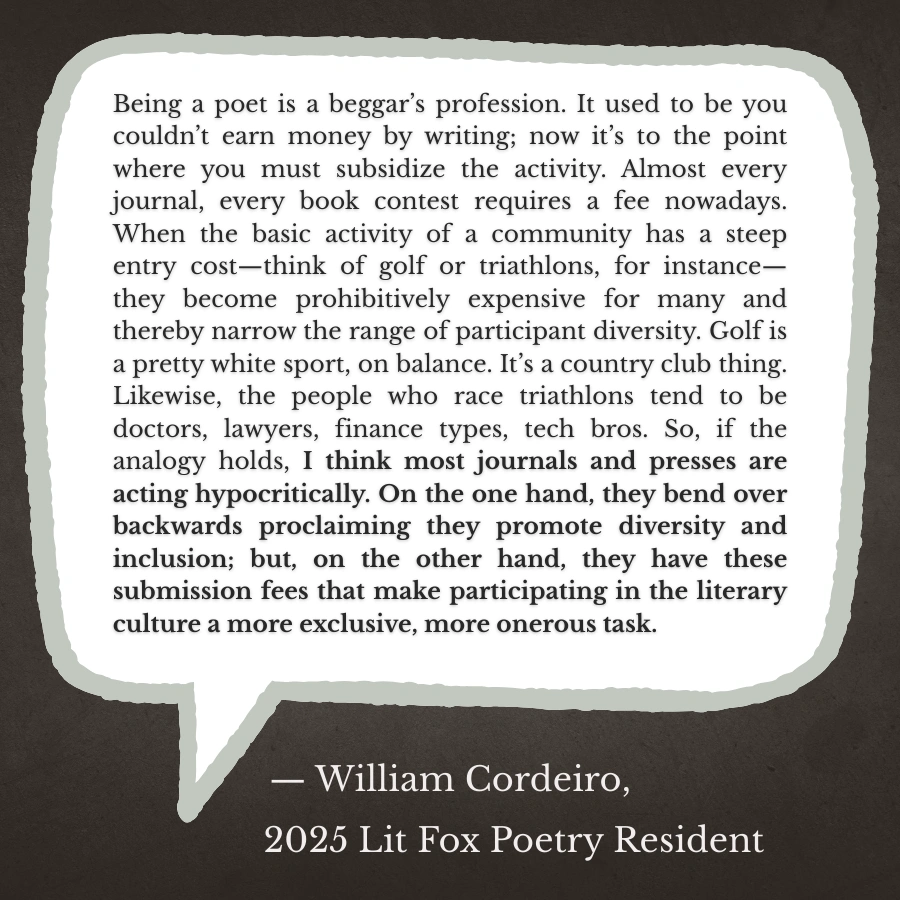
I’m skeptical of writers having to pay submission fees. Being a poet is a beggar’s profession. It used to be you couldn’t earn money by writing; now it’s to the point where you must subsidize the activity. Almost every journal, every book contest requires a fee nowadays. When the basic activity of a community has a steep entry cost—think of golf or triathlons, for instance—they become prohibitively expensive for many and thereby narrow the range of participant diversity. Golf is a pretty white sport, on balance. It’s a country club thing. Likewise, the people who race triathlons tend to be doctors, lawyers, finance types, tech bros. So, if the analogy holds, I think most journals and presses are acting hypocritically. On the one hand, they bend over backwards proclaiming they promote diversity and inclusion; but, on the other hand, they have these submission fees that make participating in the literary culture a more exclusive, more onerous task. They ask that you pay for your form rejection. Because, face it: that’s what happens ninety-some percent of the time. So, I’m truly grateful that Lit Fox doesn’t buy into the pay-to-play ethos that’s becoming the new norm.
In terms of tips for others, I guess I’d say, keep being harder on yourself but, at the same time, learn to trust your own instincts. Most of all, have fun. If you aren’t having fun, why bother to write at all? You need to sense that the effort has some returns, psychologically, if you’re going to keep coming back to scribble a little bit more on the page. You have to immure yourself to the daily setbacks. Creating habits, supportive environments, and positive frames of mind can help keep your motor going over the long haul.
Also, I try to revise work when it gets rejected before sending it out again. This can make submitting feel like part of the writing process instead of just a bureaucratic chore.
Much as photographers click a great many pictures they never end up keeping, I write many poems that might not go anywhere. I work every day on one thing or another, if only revision. Revision probably consumes the bulk of this mythical activity we call writing, at least for me. Otherwise, I translate or compose prose pieces or work on grants or scribble letters or read. I’m not lacking for literary activities or things to write.
That said, what’s the point of being “productive” anyway? This drive to be “productive” feels like it’s part of the “grind-set” of the neoliberal capitalist ethos that grinds us all down. And publishing doesn’t mean much, especially if one isn’t ensconced in publish-or-perish academia. It certainly doesn’t equate with one’s self-worth or reflect the quality of work someone does. Those who are academics or who are invested in social media probably feel a careerist urge to publish or a need to perform for their online coteries. Luckily, neither pertains to me. There would be nary a consequence if I never published another word. Nobody would care. Writing, for me, must be its own reward. The point isn’t to win prestige by some token accomplishment; some trinket or prize. The genuine need to write is a desire to access the wellspring of creativity that refashions our understanding of the world, that puts us in closer contact with the mysteries of life, that makes us feel and think and encounter a new, more vivid reality or to reclaim our own experience from which we’ve been alienated.
Daily reading and writing increase your sensitivity to inspiration: much like the practice of mediation, the more you do it, the more quickly and deeply you can slip into the state of consciousness required. Inspiration rarely knocks you down with an overwhelming paroxysm; it’s found more often in the still, small voice—the steady pulse of attention. Make yourself into a tuning fork. Coleridge once called Dorothy Wordsworth “a perfect electrometer.” If you look for them, you’ll find that signals keep vibrating all around you. Demons are everywhere. You simply need to lower the temperature and make yourself available to their disturbances. Perhaps your own belief that they’re present can conjure them from thin air. Only write when you feel inspired to write, but know that inspiration is everywhere.