

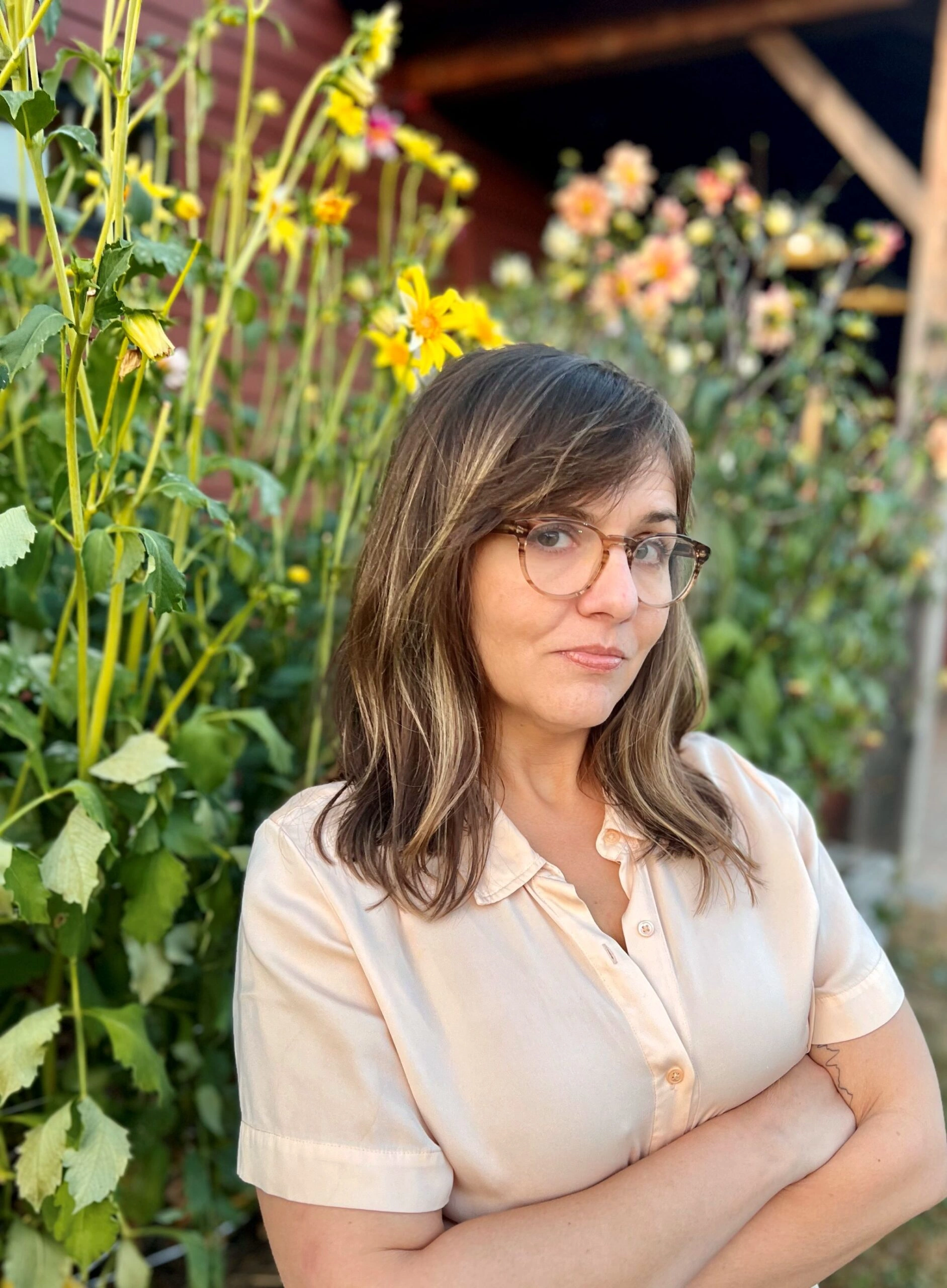
Carroll Beauvais is the author of Preverbal (Lit Fox Books, 2025) and her poems have appeared or are forthcoming in Prairie Schooner, Mid-American Review, Wisconsin Review, Delta Poetry Review, NELLE, and elsewhere. She was a finalist for the Brittingham and Felix Pollack Poetry Prizes from the University of Wisconsin Press and a semi-finalist for Alice James Books’ Beatrice Hawley Prize and the 2024 Airlie Prize. Her writing has received support from Bread Loaf Writers’ Conference and she holds a MFA from Syracuse University.
We’re delighted to share our interview between this author and our Poetry Editor Angela Williamson Emmert.
Angela Williamson Emmert: Carroll, I’m so excited to have a chance to ask you some questions about your work. Spending time with your poems was such a privilege.
In your book proposal, you wrote that Bessel van der Kolk’s book The Body Keeps Score was a genesis, or at least a touch point, for this collection. Can you say more about your process and how it came about that van der Kolk’s work would underly and inform yours? How would you describe the relationship between your book and van der Kolk’s?
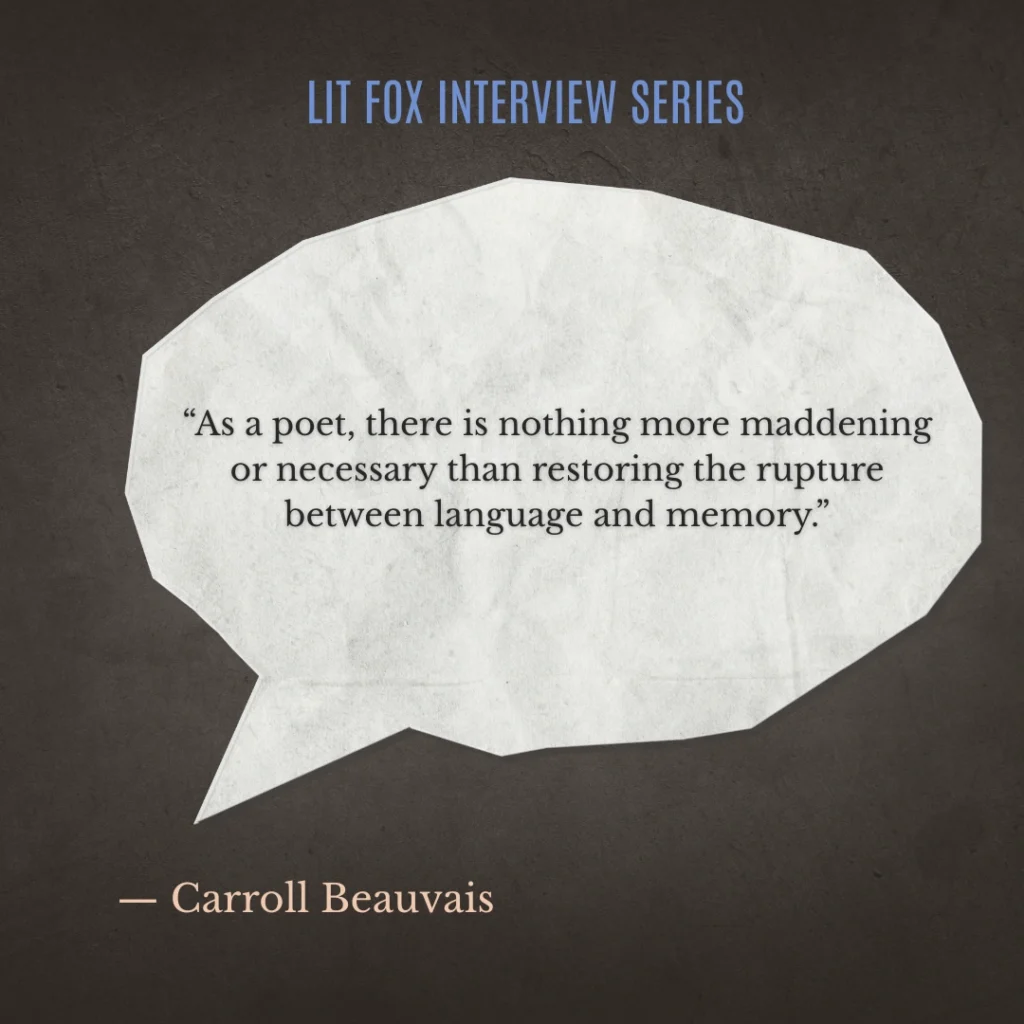
Carroll Beauvais: As with anything over ten years in the making, Preverbal contains many iterations of character, voice, self, and perspective. Upon revisiting the manuscript in 2023 (after eight years of ignoring it completely), it seemed obvious the book was really about Complex PTSD. This new awareness was informed by all the life I lived in those eight years (fresh motherhood, multiple moves, Covid), including books I’d read such as What My Bones Know by Stephanie Foo and The Body Keeps the Score by Bessel van der Kolk. “All trauma is preverbal,” resonated with me strongly, as did van der Kolk’s explanation that trauma “drives us to the edge of comprehension, cutting us off from language based on common experience or an imaginable past.” As a poet, there is nothing more maddening or necessary than restoring the rupture between language and memory.
AWE: One thing I found so compelling about this collection is the way it is structured around various opposing tensions.
The most prominent of these is between the mother and father. I don’t think it gives away too much to tell readers that the poems deal with the loss of the mother, who died very young, and the loss of a father, who died later in life. The emotional pull in these poems is towards bringing the mother closer and letting the father go.
I really love the poem “Dog River: Father’s Elegy” with the lines “You leave the urn like exhaust from a tailpipe. / There was more and more of you until there was none / left….” This poem is followed by another personal favorite of mine, “The Science of Longing” with the lines “I am a daughter / sitting opposite my dead mother….the distance between us / as large as the gravitational pull / between binary stars.”
The idea, or perhaps just the feeling, of a “pull between binary stars” permeates this collection. Can you talk more about this tension in relation to form in your collection? How did this tension affect how you arranged the poems and created the sections?
CB: First, let me say, if any of my students are reading this, they must be laughing because I obsess over and emphasize the importance of tension in any written work.
As for structure, I wanted the book as a whole to have a satisfying narrative arc, but it was also crucial to represent how trauma repeats and reverberates across a lifetime. Given all that, I hope to show time passing and the speaker’s development, even as trauma and memories ebb, flow, morph, and return—thereby suspending and bending the entanglement of time and memory. While there is a general movement forward in time, I also interspersed poems out of the narrative chronology to represent the recursion of memory, grief, and loss.
AWE: Another great example of a binary pull in this collection are in the figures of the arsonist and the revisionist. In the poem, “The Revisionist Gives Her Resignation,” for example, the speaker says, “Sick to death // from remembering, I dive // into laundry, sorting light and dark.” In the poem “Why the Arsonist Lit the Match,” the speaker gets soap in their eyes and reacts with, “Oh, Good! Now maybe I’ll go blind / and can stay in bed forever. // Here I was thinking I was having a good day.” In another poem, “The Arsonist Turns Off Television,” the speaker admits, “I dream my mother back to life only to trick her / into buying me three dresses I don’t even need.” Later the speaker asks, “’What’s the cure for loneliness?’” and is answered, “’Not other people.’”
Can you say more about these figures, the Revisionist and the Arsonist, their origination and how they made it into this collection? Specifically, can you comment on their role in the collection, both as concept and perhaps in terms of how they contribute to the book’s form?
CB: The Revisionist and the Arsonist are personas born from our dual impulse to both make sense of the past and to annihilate it. The push and pull tension between these twin desires lives in the aftermath of grief and trauma. These personas allow the speaker to respond from a different point of view without being as beholden to the “I” as in the other poems. Revision is a do-over, a chance to get it right or even reimagine a better version. There’s a longing in wanting things to have been different. The Revisionists’ binary is the Arsonist who rages and burns anything left to the ground with the fury of grief. Personally, I think in isolation, neither impulse is satisfying or useful. But when paired in tension with the other, the relationship between the two can teach us something about the spaces where they may meet.
AWE: Another tension in this collection is revealed in the four poems titled “Fragment from the Mountain of Things I’m Not Allowed to Speak.” Two of these poems share a figure of a boy. In one of these poems, the speaker says, “The arm can be the stick the starving boy / in the woods cuts notches in / to count the days he’s lost.” In a later fragment, the boy reappears and “Buries my voice, my trembling.” The poem concludes, “No one wants these limbs I chewed off.” Can you talk about the origin of this figure or how you see his role in the text?
CB: I was reading Roland Barthes’ A Lover’s Discourse around the time of writing these. The relationships, both in form and language, between a lover’s absence with abandonment and between the desire to be known v. the fear of being seen, all struck a chord as I meandered the landscape of a grieving child. When my mother died, I missed the specific person, but I also having someone to fulfill the role of mother. The boy and his response to the speaker function as a “figure” to reflect the solitude of grief. No one misses the same person in the same ways.
AWE: I noticed two prominent themes in the “Fragment” poems that also move through the collection. One is the speaker’s incredible loneliness. The other, though, is the idea of another child accompanying the speaker through childhood. This imaginary second child is first introduced in “Prologue: I’m Losing” which opens with the speaker addressing an unidentified “you”: “Tell me again about the time we were babies and our thoughts were music.”
In “Porch light, Moonlight, or the Neighbor’s Bedroom,” the speaker again speaks to an unidentified you, but this poem is preceded with the dedication: “For my sister, if I’d had one.” The opening line says, “When we were children, we dreamed the moon / full of pink lakes, swimming holes with no water moccasins.” In the center of this poem is the revelation that the sister figure is sick with cancer. The poem ends with an image of autumn, “Yellow leaves curl on the lawn in the afternoon sun, / the small, wilted hands of a child.”
However, the sister reappears later in the collection in the poem “Night Flight by the Emergency Exit” when a stranger says, “Please tell your sister I’m sorry for her loss.” The speaker reveals, “But I don’t have a sister and was alone on the flight, air shot through time…. I wanted to be someone’s child.”
Can you speak to us about this sister figure? How did she enter this collection? What role, if any, do you see her playing?
CB: Art has the power to make us feel connected when we are otherwise isolated. And just as art allows us to imagine new ways of survival, so does the imagined sister for the speaker. Her creation is a projection of the speaker’s yearning to be less alone in the world. She can be read as a figure, like the starving boy in the woods, but she’s also a much more intimate fabrication. Rather than a random fellow traveler, the sister is a character who can bear witness and endure a shared experience with the speaker. However, since she only exists in the speaker’s imagination, I hope the sister doubly highlights the speaker’s sense of exile.
AWE: I think that, in the end, your collection is about survival. The poem “Don’t Say the Earth Doesn’t Love Us” is a great example of a survival poem. It is one of several poems in the collection that describe a party scene on a beach. “This thief earth!” the poem declares, “who woos you with beach / and drink… / before death swallows. // I say, No. Give them back. // I say, Come and get me.” There’s a defiance here that I adore. Is this how you see survival, as defiance? Or are there other nuances in survival, or maybe recovery, that you wanted this collection to explore?
I believe survival can take many forms and having many meanings, and most likely these forms and meanings are not static over the course of lifetime. Many people would warn not against acting out of spite, but there’s a reason we have the cliche, “the best revenge is success.” Sometimes confident defiance is survival. Sometimes survival itself is a success.
AWE: This is an amazing collection, but I’m always curious about how artists find direction for their work after a collection like this, which was so carefully constructed that it feels as if it were conceptualized as a whole. Are you at work on more poems? Do you have a project in mind, or are you at the point of letting the work lead you? How are you moving on as an artist? What might we look for next?
CB: I can be an incredibly slow writer, or at least I feel slow. Accepting this about myself is a journey! I’m writing new poems and working on essays. I have a couple of memoirs in progress, and it’s quite possible that I’ll realize I was writing one book the whole time. That’s more or less how this collection came together. The best writing days are the ones in which I write something better and beyond my own vision.