
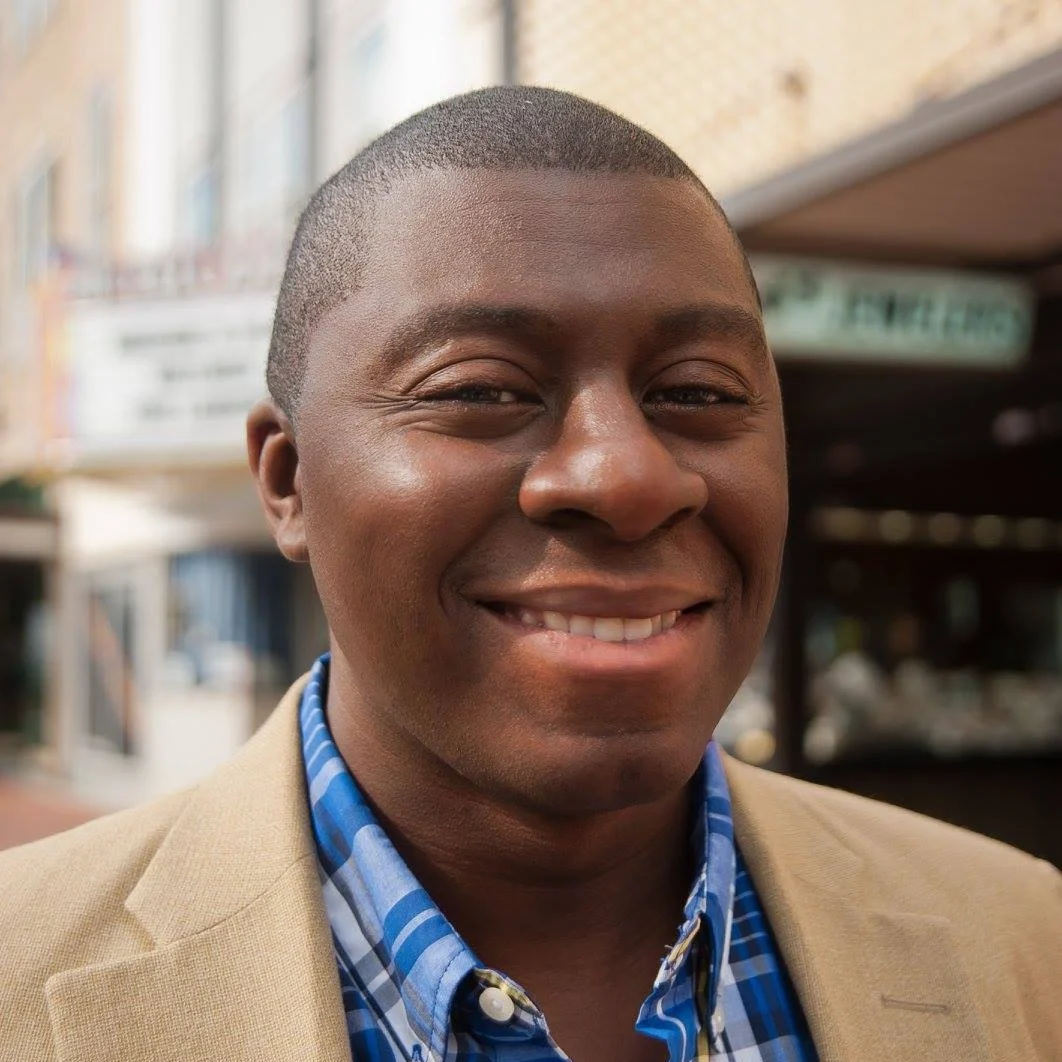
Len Lawson is the author of Negro Asylum for the Lunatic Insane (Main Street Rag, 2023) and Chime (Get Fresh Books, 2019). He is also editor of The Future of Black: Afrofuturism, Black Comics, and Superhero Poetry (Blair Press, 2021). He has received fellowships from Tin House Summer Workshop, Palm Beach Poetry Festival, Callaloo Barbados, Vermont Studio Center, and Virginia Center for the Creative Arts, among others. His poetry appears in African American Review, Callaloo, Mississippi Review, Ninth Letter, and Verse Daily. Len earned a PhD in English Literature and Criticism at Indiana University of Pennsylvania and an MFA in Creative Writing at Queens University of Charlotte. Born and living in South Carolina, he is currently Director of African American Studies and Assistant Professor of English at Newberry College.
Angela Williamson Emmert: Congratulations on a fabulous, innovative, and truly original book that astonishes with its breadth, both in terms of subject and form. The title, New Names for Stars, supplies the section titles, “New,” “Names,” and “Stars.” These thematic labels, though, serve not as restrictions but as invitations for expansion. Within this collection, seemingly disparate poems engage in conversation, drawing subtle and unlikely connections.
In the section titled “New,” for example, a series of prose poems interweaves questions of love, identity, the deep past, and space. The poems in “Names” orbit a central voice, who is identified in the poem “Len, We Added a Movie You Might Like.” In “Stars,” the poems look outwards, where we find historical figures, living athletes, and characters of comic book fame!
Could you describe how this collection found its shape? When did the form and organization emerge? Do you have thoughts, approaches, or preferences in the arranging of a collection? Are there other poets or collections that inspired or influenced you or that you admire for their use of form?
Len Lawson: From what I observe in poetry publishing, collections are moving toward hybrid forms with photography and visual art while traditional forms are constantly being broken or adapted to a poet’s imagination or preference. The contemporary poetry collection is consistently evolving (or eroding if you please) into something malleable and organic, more interpretive and breathable without canonical restrictions.
I did not feel a pull to make this a collection at first, but I eventually discovered that I was trying to discover new worlds. Arrangement can be as loose as one word like you see in these poems. I heard the title in my mind and gathered the pieces together almost like trying to clutch the wind, perhaps with less success yet with the joy of the challenge.
I admire collections that break perceived rules and take risks like those from Terrance Hayes, Keith Wilson, and newcomers like Desiree Bailey; it shows character and courage to dare to be different which I believe editors and judges appreciate—seeing something they haven’t, something that can’t be replicated.
AWE: Your use of the prose poem form is phenomenal. These poems pulse with energy, situating Black bodies and Black identity in both time and space. They literally contain worlds. The extraterrestrial, spiritual, and dream worlds; the imaginary, the mythical, and the mundane worlds; and the world of science all overlap, expand, and recede. Poems with lines like “a black body must ask if it is the star or the darkness” and “my planet’s bodies are her auto-immune disease…” push us towards interstellar perspectives. We confront both Judeo-Christian and pre-Christian gods when “lucifer crashed to the earth with […] violence,” and “Aphrodite charmed Paris into seducing Helen, and Troy burned with a passion for war. YHWH appeared in a fiery bush, craving Moses’ lips as much as children crave the darkened, gorged areola, veined with lightning…..” These poems look to personal histories: “In my dream, I prepare an African dish for the first time.” And they look to the far-flung future: “science fiction is the pornography of physics, titillating formulas, manipulating our own depraved desires” and “see our people in the future, ink of their skin canvassing the night sky….”
Can you share your thoughts on prose poems in general and your experience writing these particular poems? What was writing in this form like for you? How did these poems come to be within (or because of) this form?
LL: I admired the block prose form of the first section for its ability to contain suspense and anticipation in the tight, pristine structure like designer suitcase. I wanted the line breaks to matter and closings to be unpredictable and interpretive—like the suitcase being left open.
I wanted to go off the cliff into world building. How could I describe something I couldn’t see and have never seen before? Through poetry, I presumed. I look at a collection like Tracy K. Smith’s Life on Mars and say, Now that’s world building, because she’s imagining things from both memory and from light years away never seen. The only way you can describe what you’ve never seen is to describe it with things you have. My translators are usually pop culture, superheroes, sacred texts, and other literature since these are what raised me. I also took risks with trying to translate through science which is definitely not my safe space, but that’s the beauty and terror of risk-taking.
AWE: A fascinating aspect of the “Stars” section is the seamless juxtaposition of real people and figures from the collective imagination. Amanda Waller, Venom, and Frozone’s wife exist alongside Simone Biles, George Stinney, Jr., Guy Bluford, and Chadwick Boseman.
The poem “Portrait of George Stinney, Jr., as Police Report and Trial” deserves special notice. It takes its form from police and court paperwork. Labeled boxes and tables normally filled in by bureaucrats and authority figures here hold space for a buried history. Footnotes add a layer of commentary that reminds readers how justice itself is routinely reduced to an ancillary concern.
Would you like to comment on the George Stinney, Jr. poem and the theme of justice in this collection? Can you describe the worldview informing the “Stars” section, where tragedy and celebration, and the real and the imagined, live side-by-side as equals? What was your process as you wrote these poems and compiled this section?
LL: For me, the middle section really highlights the book title because these are indeed the new names. I researched the mythological names for stars like Orion, Cassiopeia, Andromeda, and others, but we have figurative stars living or who have lived among us whose life cycles mirror the celestials.
I lived for ten years near the small town of Alcolu where Stinney grew up. I became more acquainted with the tragedy surrounding him, and I knew of little to no other works being written about him beyond news and documentary. Nikky Finney has written a powerful epic ballad about him called “Black Boy with Cow: A Still Life” in which she details attending Stinney’s posthumous exoneration proceedings 70 years after his state-sanctioned execution. The poem in my book follows a Hayes poem in How to Be Drawn in which he first used this brilliant police report form. For me, there’s a fine line among the art, witness, and documenting with historical poetry. I don’t want to simply report what people can research for themselves. I heard Patricia Smith confirm at Palm Beach Poetry Festival what I’ve always thought about ekphrastic (and this historical) poetry, which is to find an alley, a nook, a small crack or window into the events and build out from there with a microscopic lens first rather than with an encyclopedic view.
AWE: The Amanda Waller Suite, also part of the “Stars” section, first appeared in an anthology you co-edited with Gary Jackon and Cynthia Manick titled The Future of Black: Afrofuturism, Black Comics, and Superhero Poetry (Blair Publishing). Can you talk about your work with Afrofuturism and how it informs your thinking and the poems in this collection?
LL: Poets like A. Van Jordan, Gary Jackson, and even Lucille Clifton are the real pioneers of this cerebral, superhero poetry. I’m into Afrofuturism poetics also as scholarship after a childhood of loving superheroes and sci-fi yet denying my blackness to fit into white spaces. I now fully lean into the weight, power, and depth of living in a Black body. To me, a George Stinney or a Slave Gordon/Whipped Peter can be seen just as much a superhero as Black Panther or Storm from X-Men when the lens is trained on the real-life story arc and their superhuman abilities. Simone Biles, Chadwick Boseman, and more Black icons are indeed superheroes without the capes; they transcend our realities yet remain these mild-mannered humans. Their comics could be sold right next to Justice League and Avengers.
AWE: Congratulations on your inclusion in the Poets and Writers December 26, 2025, newsletter, which spotlighted you as a “Winner on Winning” poet! In this interview you said, “Honestly, this [collection] might be my last hoorah for a while” (with luck, time proves this pronouncement false!) and added, “This manuscript is comprised of work that I wanted to write and not what I thought the industry wanted to read or hear.”
Your statement makes this collection sound deeply personal! Can you tell us more? What are your thoughts on writing “what the industry [wants] to read or hear”? Do you see poets and artists pressured away from their authentic work? How (and why) do you—and how might others—resist?
LL: Straight up, poetry can be a ruthless, cutthroat, demoralizing business. Writers are going to see this, so they already know the statistics of acceptance and rejection. I don’t care who you are; that takes a toll on your soul, body, and spirit. In all transparency, I was done with the rat race and ready to walk away because I didn’t think my work was advancing in the spaces I felt it should, and I really had peace with that. On the other hand, I didn’t want to walk out on the poems I’d been writing because I still liked them and felt they had merit and deserved a voice. Submitting to the Lit Fox Contest was, in my mind, my last hurrah. I was ten years into publishing poetry and felt I was hitting a wall, so I was good with my bag of accomplishments. When the email came about winning, I just said, Wow. Okay, here we go then.
Let’s be honest. We know there’s no standard formula to success in poetry despite attending the workshops/conferences, reading endless books from our idols and peers, and utilizing the so-called tools, jewels, and nuggets given us, and everyone cannot be in the fraction of those whom we admire standing at podiums receiving awards and recognition. I say this with a laugh, but I don’t wish this life on anyone…until it happens to you! It’s indescribable to experience how something that started as an idea, a dream, a hunch, or a wish can become a tangible book—or dare I say, a badge or trophy—in your hands that other people will be thankful that you decided to birth into the world. That’s why we keep coming back to the page or screen and keep trying to describe the indescribable—keep rising up against our deepest fears and anxieties…because these buried feelings and improbable journeys were somehow, somewhere birthed into us, awaiting their arrival.
But truly I could have walked away before this humbling honor and have been okay with my life. I am ever so grateful that I did not have to.